Wednesday, 10 February 2010

Prelim Task - Our sweded film

I've chosen to swede Harry Potter and the Philosopher's Stone with;
  • Beth Cooper
  • Emmie Bryett
  • Jamie Baldock
  • Joel Colborne
  • Melissa Hodgson
I chose this film to swede because it has the best potential for being funny.
We will film the best parts of the entire film instead of just the opening.
This film also uses a lot of special effects, therfore recreating them with only the props we can get our hands on will produce comical material.

In order to swede this film we will need tho following items for costume;
  • Dumbledore's beard and hair
  • Capes
  • Wizard hats
  • Hagrids wig
For props;
  • Wands
  • Harry Potter glasses
  • A baby
  • A trolley
  • Feathers
  • Brooms
  • Mrs Norris the cat
We will film mostly in school.
For the Quiddich match we might need a field or use one of the tennis courts in school.
Some of the scenes will need to be filmed at night.

Summary of Harry Potter And The Philosopher's Stone:
A young boy named Harry Potter discovers that he is a wizard. He is introduced to the wizarding world and is then sent of to Hogwarts school of witchcraft and wizardry. He befriends a young ginger boy, Ron Weasley and an intellegant young muggle born girl, Hermione Granger.

Whilst at Hogwarts Harry learns how to play Quiddich, cast spells and make potions. The three of them discover a three headed dog which is guarding something in the school, they then set about trying to discover what is going on with the help of the grounds keeper, Hagrid. They suspect that Professor Snape is behind it but Harry discovers it was infact Professor Quirell, and has his first encounter with his nemesis Voldemort.


Characters:
  • Main character, Harry Potter - Joel Colbourne
  • Harry's friend, Ron Weasley - Me (Emma Graveling)
  • Harry's friend, Hermione Granger - Beth Cooper
  • Grounds keeper, Hagrid - Rob Cranley
  • Harry's cousin, Dudley - Emmie Bryett & Edwin Heavisides
  • Hogwarts Headmaster, Dumbledore - Beth Cooper
  • Professor McGonagall - Me
  • Professor Flitwick - Melissa Hodgson
  • Professor Snape - Jamie Baldock
  • Professor Quirell - Beth Cooper
  • Ron's Mum, Mrs Weasley - Emmie Bryett
  • Ron's Sister, Ginny Weasley - Melissa Hodgson
  • Mr Filch - Edwin Heavisides
  • Hogwarts student, Seamus Finnigan - Jamie Baldock
  • Hogwarts student, Neville Longbottom - Jamie Baldock


The prelim task section can be found within the harry potter swede at 6.52 minutes to 7.09 minutes. It includes examples of match on action, shot/reverse shot and 180 degree rule.
The prelim task requires good use of continuity editing, which makes the film flow and the shots appear coherent. We will need to practise this so that when it comes to making our film openings we are able make good use of continuity editing as we recieve more marks for a range of shot types which will need to be coherent.
Match on action is a type of eliptical editing, which shows an action happening and the subsequent action following it, for example; somebody throwing an object, and the following shot would be another person catchin the object. Our example shows Joel [Harry Potter] placing his hand on a door handle, and the subsequent action in the following shot is him coming through the door, the eliptical editing cuts out the scene in which he actually opens and walks through it.
Shot/reverse shot is when two different camera are filming two different people looking at each other or one person looking at an object or event happening, the shots are then edited into a sequence so signify this.
The 180 degree rule is that in order to film shot/reverse shot to work properly both cameras must be on the same side of an imaginary 180 degree line, without it both of the people, or the person and the object etc would look like they were in the same position.
There are other examples of match on action, shot/reverse shot and the 180 degree rule also used through out the film swede.

If we had tried to recreat 'Harry Potter' more accurately we would have faced these problems
  • Settings would be limited, therefore scenes such as; Diagon Alley, the train and boats as the characters arrive at hogwarts, hogwarts castle, the quiddich match and the obstacles on the way to finding the philosipherstone such as the giant chess board.
  • Costumes and props would lack verisimilitude due to lack of budget.
  • CGI and SFX would be needed to realisticly portray magic and we wouldn't have access to it.

Monday, 8 February 2010

My initial pitch

My idea for a film plot begins with a group of six teenagers, three boys and three girls going on a camping trip.

The opening would begin with the group in a car, and they would pull into the car park so i would have establishing shots of the location and then pan to the car and track it as it pulls in to thee car park. The plot is that there would be a psychotic character parked in the carpark and he would watch the group set up to go camping. I would film this by having long shots of the group to signify that they're being watched. 

Next i would include medium shots of the group as they organise themselves and set up their camp, i would cut to more long shots which i would film with a hand held camera and shoot through trees to further signify that they're being watched.

Then one of the girls would set off to collect some wood for a fire, and not return. I would set this scene just as it was getting dark, and use more long shots through the trees of her walking away from the group. I would then get a medium shot of her bending down to pick some wood up and have him looming over her with a knife in his hand and then have the screen fade to black with an audio bridge of her screaming.

The rest of the story would be that, the group wouldn't notice that she hadn't come back for some time, then a couple would leave the group for sexual activity and stumble across her body lying in a ditch covered in blood. They would then return to the group and raise the alarm.

Some of the group would then go and retrieve her body whilst the others packed up camp and try to call the police only to find that there is no signal. Once the others come back with the body they would all set off back to the car park to get away from the woods, however the car wouldn't be where they left it.

Two of the male characters would then go try to find the car whilst the other boy stays in the carpark with the two remaining girls.

At this point it would be getting dark and the two boys would end up seperating, one gets killed by the psychopath, while the other returns to the carpark. The girlfriend of the missing boy would then try to find him and ends up falling down a ditch and spraining her ankle.

Then the other three would decide to set off walking and whilst walking they would hear the girl calling for help, one of the boys would run to save her but the psychopath would be hiding around a corner and kill them both.

Then there would only be two people left, a boy and a girl. As they continue to walk they would spot a car in the distance parked up with headlights. They would head towards it calling for help only to realise that it's their car and it's empty. They would get in and drive off.

Half way down the hill the psycho would be stood in the middle off the road brandishing a large knife, they would speed up and run him over, and then try to stop and get out to see if he's ok, but the psycho would have cut the breaks and the two characters would crash. Then in typical style of horror films the final girl would become concious in the morning and be the only person who survived.

My idea is the one my group have decided to go with, therefore we may need to improve on this.

Seven Evaluation Questions

The following 7 questions will need to be answered in the evaluation of our coursework:
  • In what ways does your media product use, develop or challenge forms and conventions of real media products?
  • How does your media product represent particular social groups?
  • What kind of media institution might distribute your media product and why?
  • Who would be the audience for your media product?
  • How did you attract/address your audience?
  • What have you learnt about technologies from the process of constructing this product?
  • Looking back at your preliminary task, what do you feel you have learnt in the progression from it to the full product?

Microdrama & Narrative Theory

Todorov's narrative theory states that most stories begin with equilibrium, something then disrupts this to create dis-equilibrium, and then that is resolved to finish with a new equilibrium.

Vladimir Propp's narrative theory states that 8 stereotypical character types in most stories, they are;
    • The Hero
    • The Villain(s)
    • The Dispatcher

    • The Helper
    • The Donor
    • The Princess


  • Her Father
  • The False-Hero
The plot of our microdrama was, that there was a villain with a teleporting watch who kidnaps the princess and injures the false hero. The hero and the helper find the false hero and take her back to the dispatcher who tells them all that they need to go defeat the villain, take back the princess and destroy the watch. We didn't have the father character as there was only 6 people in our group. The donor which can also be a magical object was the watch itself. When the hero returns the false hero tries to take credit for saving the princess and destroying the watch but the helper proves the who was the real hero, and the princess rewards the hero with money.

Wednesday, 3 February 2010

Initial Notes on Film Openings

Here are some notes on film openings that we have watched in class the past few weeks

Cry Wolf  - 2005 Director: Jeff Wadlow
  • begins with blank black screen, audio bridge is used
  • their is a self contained narrative section which lasts around 2 minutes
  • no dialogue, little exposition is provided
  • short takes signifies action
  • lots of shot variation
  • horror genre is signified by the setting and the colour filter
Halloween - 1978 Director: John Carpenter
  • the opening of this film is unusually filmed
  • long titles 1.59 mins accompanied by theme music from film
  • uses one long continues take for 5 minutes plus
  • point of view shot with shakey camera work, signifying realism
  • point of view shot of character before seeing the character
  • exposition from text on screen, location and date
  • horror genre is anchored by blue colour filter signifying cold atmosphere, the music which interferes with the heartbeat.


Bride of Chucky - 1988 Director: Ronny Yu
  • begins with establishing shot of building
  • American flag and then close up of sign provide exposition on location.
  • dutch angle signifies something is wrong
  • night time, blue filter, stormy weather plus thunder and lightening, all signify horror
  • hockey mask - intertextual reference to the film Friday 13th
  • example of a false scare
  • stereotypical attractive female on screen for male gratification
Maltese Falcon - 1941 Director: John Huston
  • serif text titles. signifies serious film
  • Black and white film
  • Scrolling text on screen provides exposition of plot
  • establishing shots, plus location name on screen also provides exposition of setting
  • lots of dialogue
  • soft classical music plays throughout long opening scene

Clerks - 1994 Director: Kevin Smith
  • documentary style font signifies plain simple realism
  • audiobridge of diegetic sound, further conveys realism
  • mise-en-scene of untidy bedroom provides insight into character before they appear on screen
  • first character (central protagonist) on screen falls out of the cupboard, polysemic image - possibly signifies being drunk, being strange, being too lazy to get into bed etc
  • long takes with cut away shots to the dog
  • eliptical editing matched with introduction of non-diegetic rock music
  • variety of shots of object used whilst the central protagonist gets ready for work
Napoleon Dynamite - 2004 Director: Jared Hess
  • credits run for 3.33 minutes
  • creative titles making names out of food
  • cards provide exposition as to setting
  • first character on screen is central protagonist, mise-en-scene such as his outfit (glasses) signifies he is a stereotypical geek character
  • Non-diegitic keyboard music signifies light hearted comedy
  • dialogue provides exposition
  • still frames mimic a comic strip style
  • lots of shot variation
  • little insight into film plot from the opening
Shaun of the Dead - 2004 Director: Edger Light
  • audiobridge non-diegeitc music switches to diegetic as it plays from a duke box - an American song, help to achieve cross over appeal.
  • the opening is a self contained narrative section lasting approximately 3 minutes, titles follow this.
  • comedy genre is signified through the narrative which is humourous
  • social realist genre is signified through the setting in a local pub 
  • horror genre is signified through the song choice but that is left relatively polysemic and may be ignored, leaving the audience following the opening in a negotiated reading.


Hot Fuzz - 2007 Director: Edgar Wright
  •  opens with establishing shot of a corridor and the central protagonist in the far distance
  • an audiobridge of police siren is used, this signifies action and crime genre
  • lots of shot variation and fast pace editing further anchor the prefered reading as to the genre
  • a voiceover, from the main character, is used to provide exposition

  • non diegetic punk song by Adam Ant from the 80's targets an older audience
  • comedy genre is signified slightly in the opening but is left slightly polysemic
RocknRolla - 2008 Director: Guy Richie
  • titles are animated, and acompanied by guitar music which could possibly signify comedy genre
  • a voiceover is used to provide exposition, south London accent signifies working class
  • an antagonist character is signified, he isn't the first on screen, shots of his shoes and bodyguards are shown before his face which signifies importance and wealth
  • exposition from dialogue signifies action and comedy genre and suggests a male audience
  • self contained narrative section lasts approx. 5 minutes and provides insight into characters
  • shot variation and some parts of fast pace editing also signifies action genre
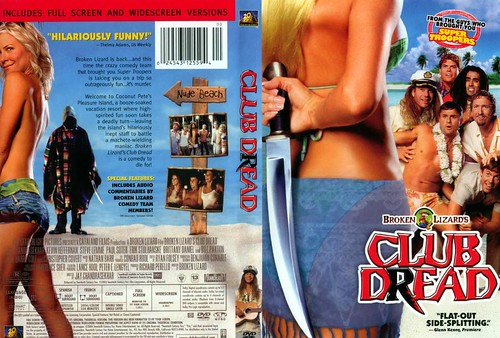
Club Dread - 2004 Director: Jay Chandrasekhar
  • self contained narrative section lasts around 7 minutes, relatively long opening
  • establishing shot of an island signifies location of film
  • documentary style font on screen provides exposition of the exact setting
  • range of shots used, pans in from long shot of the whole island to shot within the island forrest
  • first two people on screen aren't signified as central protagonists
  • diaglogue containing sexual references and nudity make the film a 15 rating
  • comedy genre is signified through the dialogue
  • horror genre is signified through the music played over the titles, clip of a female screaming, the dialogue and the setting within a graveyard/tomb

COURSEWORK TASK

Preliminary exercise: Continuity task involving filming and editing acharacter opening a door, crossing a room and sitting down in a chair opposite another character, with whom she/he then exchanges a couple of lines of dialogue. This task should demonstrate match on action, shot/reverse shot and the 180 degree rule.


Main task: The titles and opening of a new fiction film, to last a maximum of two minutes


All video and audio material must be original, produced by the candidate(s), with the exception of music or audio effects from a copyright-free source.

Tuesday, 2 February 2010

FILM OPENING PRESENTATION

Film Opening Presentation - Where The Heart Is - [2000] [Director: Matt Williams]


I chose to analyse the opening to this film because, despite being a romance film it doesn't follow conventions of romance films.
It clearly displays people of a working class background
It fits the opening and the titles into exactly 2 minutes